Jobs-to-be-done Research at Grover

Domain(s)

App & Web Experience

Platform

All Platforms & Countries

My responsibility

Product Lead @ Grover

Release

June 2025

Disclaimer: To respect confidentiality, all data in this case study has been fictionalized. The focus here is not on the insights themselves, but on the frameworks, steps, and techniques I used to uncover real user insights and turn them into meaningful product opportunities.

To better understand and serve Grover’s largest user segment, first-time renters, I led a research initiative using the Jobs-to-be-Done Canvas 2.0 framework. The goal was to uncover what truly drives users to rent, what challenges they face, and how we can improve their experience. The result: a prioritized list of user jobs, mapped decision journeys, key job differentiators, and rich insights into the emotional and social context behind renting. Backed by both qualitative interviews and quantitative validation, this research is now informing strategic decisions across teams and provides a repeatable framework for measuring the impact of future product development.

Situation

Designing for the Majority We Barely Knew

At Grover, a big share of our platform visitors are new users, yet we knew surprisingly little about them. Most of our existing research was outdated, with some insights dating back more than four years. Even worse, almost all of it focused on existing customers, not the people still deciding whether Grover was right for them.

This created a critical blind spot. We were designing flows, messaging, and features for the moment of decision, but with limited understanding of what actually drives or blocks first-time renters. If we wanted to improve conversion, we had to stop guessing and start listening.

Task

Turning First-Time Rentals into First-Class Insights

In the Acquisition team, I’m heavily relying on data but also user insights to make decisions as Product Lead. Since our core business is in Germany, and I’m one of the few German speaking Product Managers at Grover, Product Discovery became one central piece of work for me.

My goal was to apply the JTBD Canvas 2.0 framework to better understand new customers who recently placed their first rental. I wanted to identify where our experience supports them well, and more importantly, where it doesn’t. By having a list of Jobs, that have been verified by quantitative as well as qualitative research, we would have strong arguments for the business to set a direction and make decisions that I can use as a Product Lead. This research is intended to: Challenge internal assumptions with real user data. Support more impactful, user-centred experiments, especially on key surfaces like the homepage. Align efforts with Grover’s new brand strategy.

With the Jobs-to-be-done Canvas 2.0, we aimed to:

  • Understand the jobs of new renters and how important vs satisfied each one is
  • Which steps they take in their user journey
  • What factors differentiate their jobs
  • How they feel and want to be seen

The speciality about the JTBD framework is that you’re not asking customers directly about what they want. You hear their story, ask questions about how they did things in the past and avoid everything hypothetical or they mention about maybe doing in the future. From their story, you use a standardized format to get your insights.

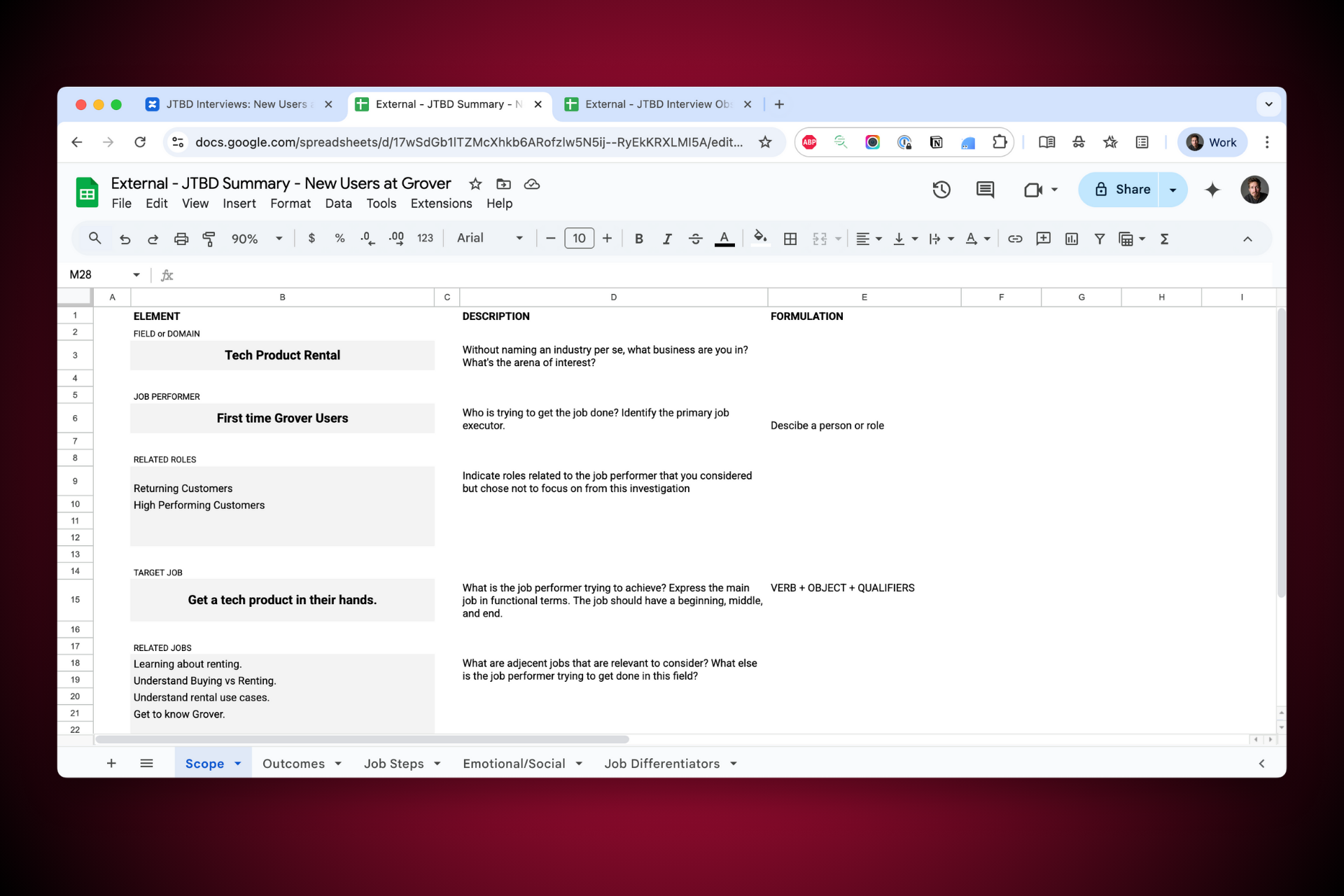
Job Performer

First-Time Grover Renters

At least one approved order

Based in Germany

Target Job

Get the desired product in their hands.

Related Jobs

Learn about renting.

Understand buying vs renting

Get to know Grover

Actions

From Stories to Strategy: How We Ran Jobs-to-be-Done at Grover

To bring structure and depth to our research, we followed the Jobs-to-be-Done Canvas 2.0 methodology, moving from qualitative interviews to quantitative validation. This allowed us to connect user stories with real business opportunities.

We targeted users in our core market, Germany, who had completed their first rental within the last two months. This gave us fresh, detailed insights from people who were still close to the experience.

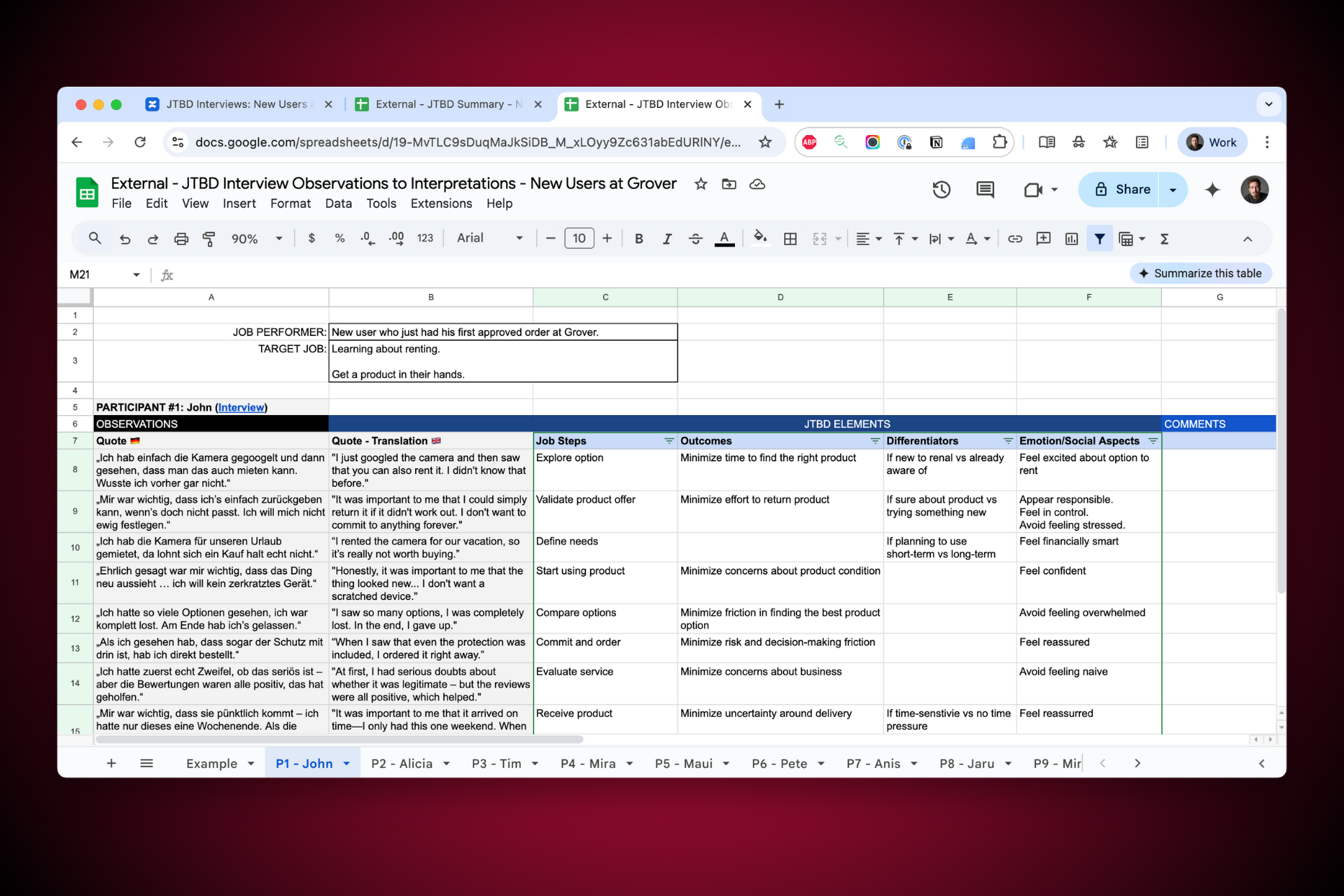
I interviewed 16 new customers, ranging from students to a retired particle physicist. Instead of asking abstract or hypothetical questions, we let them tell their stories, focusing on what triggered their rental, the steps they took, what they hoped to achieve, and how they felt along the way.
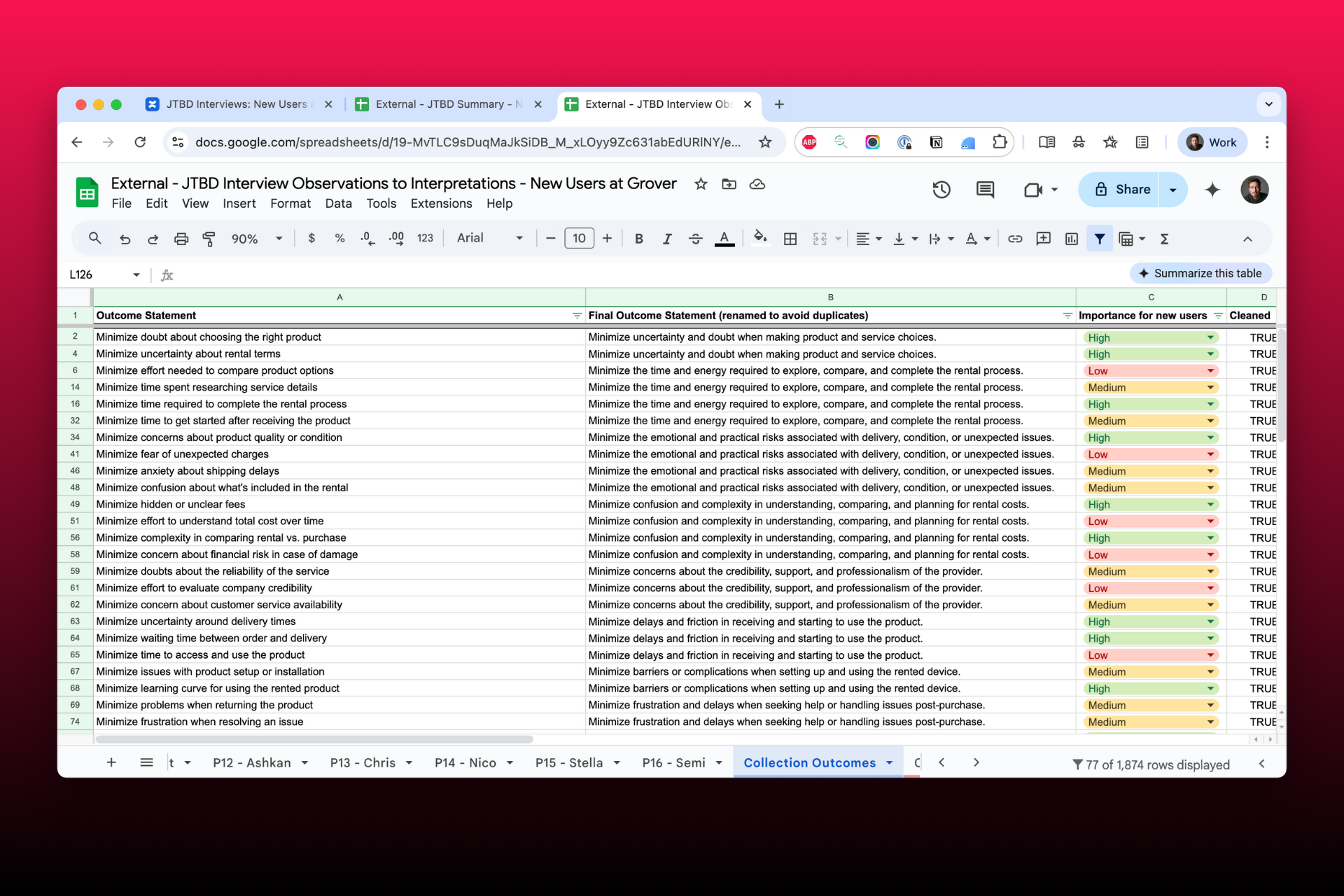
From these interviews, we extracted and clustered the most common Job Steps, Desired Outcomes, Differentiators, and Emotional/Social aspects, giving shape to a consistent user journey with multiple motivational layers.

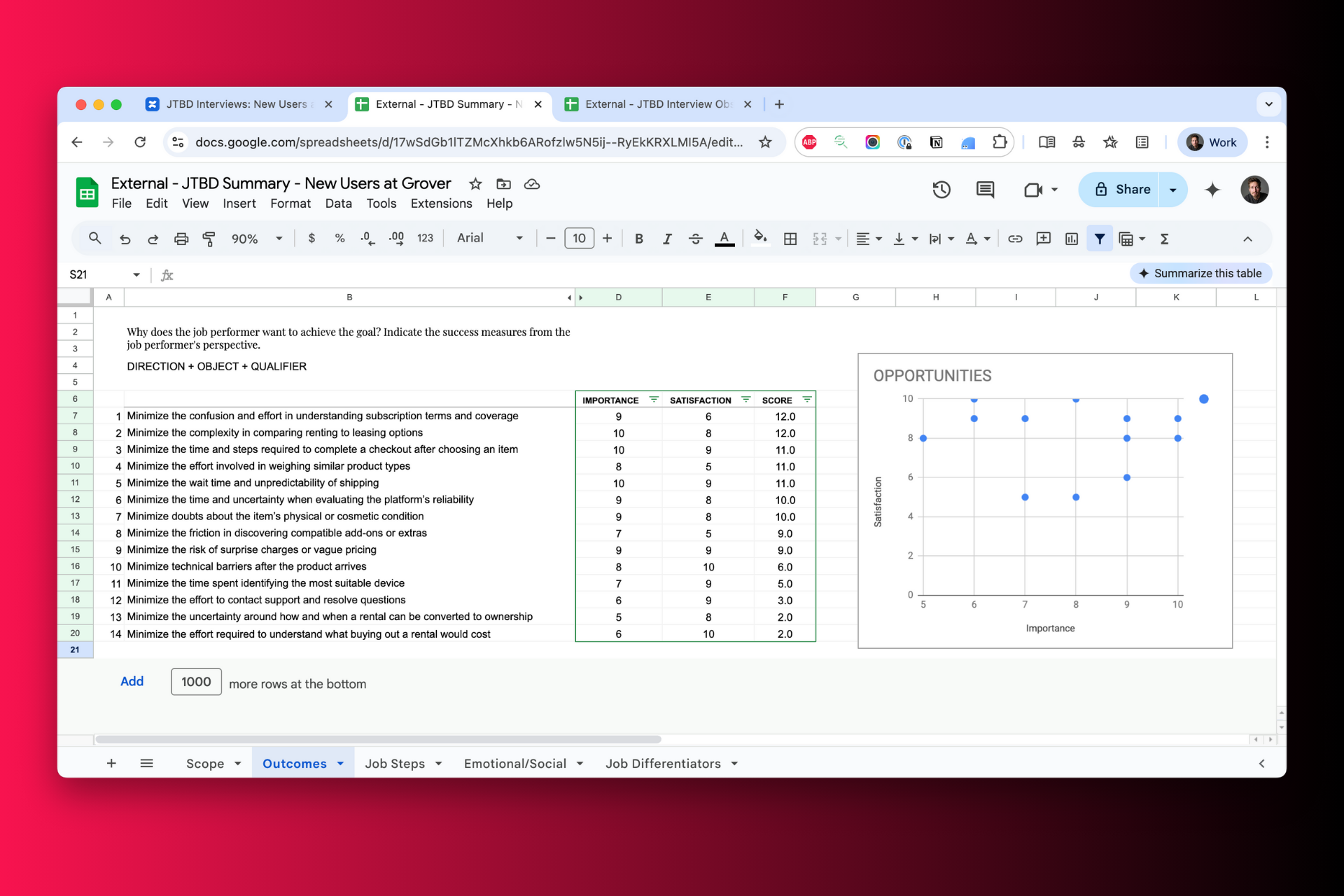
Next, we validated our findings through a structured survey. Each participant rated the extracted outcomes on two dimensions: importance and satisfaction. This helped us spot which jobs were critical but underserved, clear opportunities for product improvement.

I shared the findings across Grover, from Product to Brand teams, to challenge assumptions and refocus our work around what truly matters to new users. These insights are now shaping upcoming experiments and product iterations.

JTBD Research - Interview

Frameworks/Methods

We used the JTBD Canvas 2.0, a structured research framework combining interviews and surveys to identify opportunity areas.

Deliverables

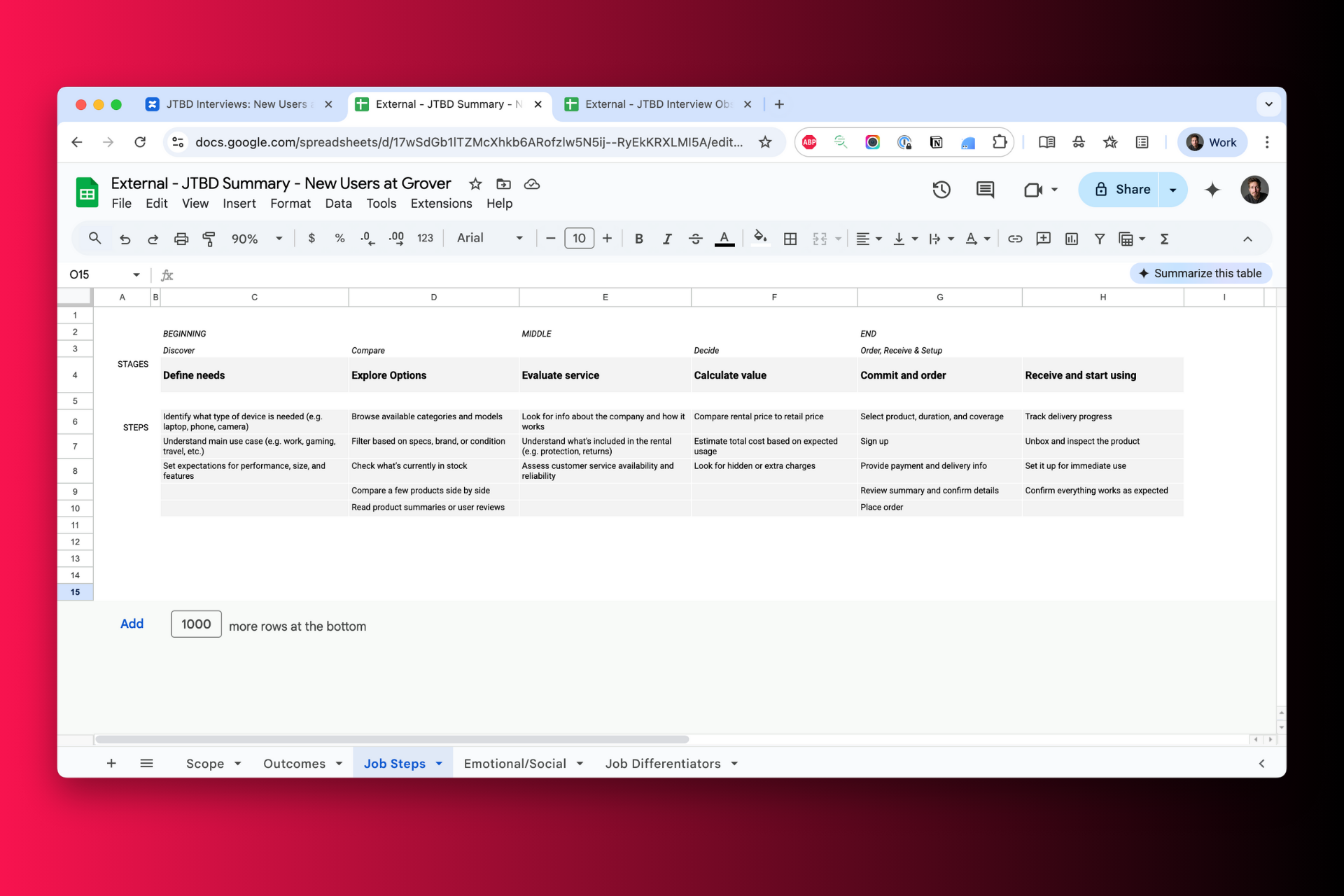
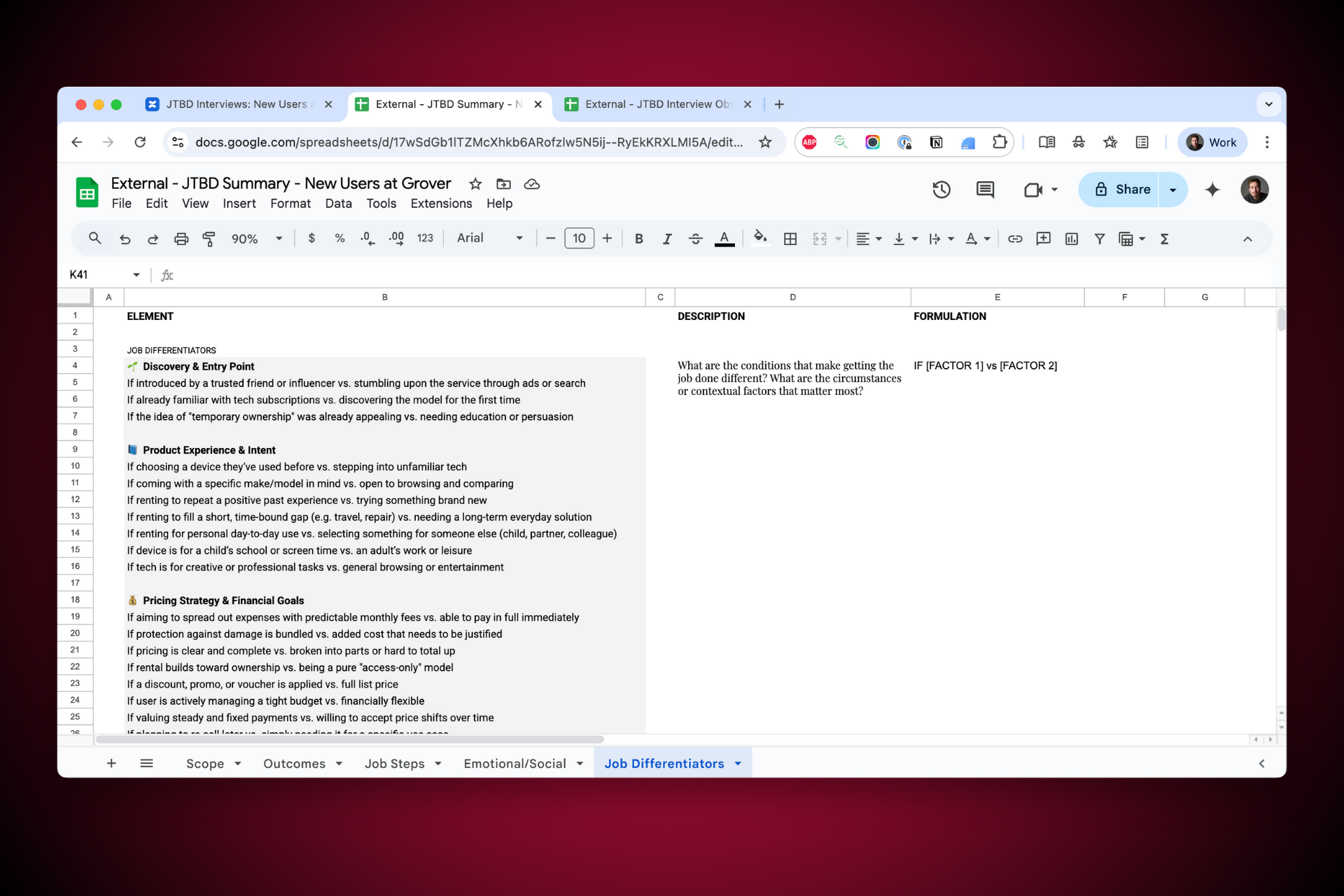
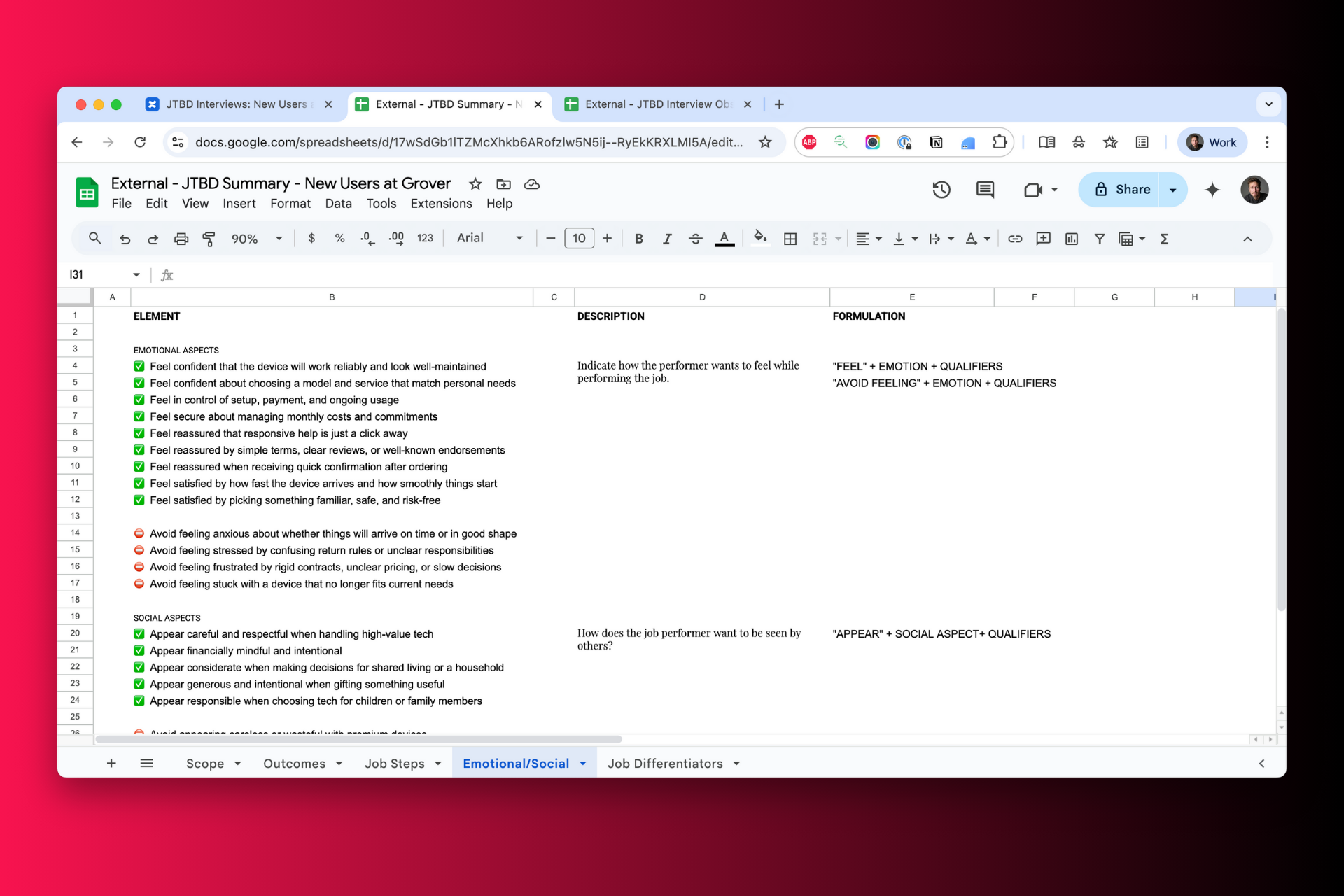
Job Steps: What steps do new users take in their journey? Outcomes: What do they want to achieve? Job Differentiators: What influences how they do it? Emotional/Social Aspects: How do they feel during the process?

Tools used

We used Google Meet (interviews), Miro (clustering), Typeform (survey), Google Sheets (scoring & analysis) and Dovetail (interview transcripts).

Results

From Solo Research to Company-Wide Impact

This was the most challenging, and most rewarding, research project I’ve led so far. From segmenting the right users, to conducting interviews and surveys, to cleaning the data and sharing the findings across the company, this project was a learning.

What we gained was exactly what we set out to discover:

  • A prioritized list of user Jobs, based on importance and satisfaction scores
  • A clear map of the actual steps users took, from first need to having the product in their hands
  • A set of Job differentiators, the factors that shaped different user journeys and decisions
  • Deep insights into how users felt, what they were concerned about, and how they wanted to be seen

The research was supported by our Head of Marketing as well as our CCO, and the findings were shared with teams across Product, Risk, Engineering, Design, and Data. It sparked valuable discussions and contributed to a stronger focus on real user needs across functions.

More importantly, the Jobs-to-be-Done framework provided us with a reproducible, structured way to capture user motivations and evaluate how well our product supports them. This creates a clear benchmark we can return to, helping us test and validate whether future developments truly serve the people we’re building for.

Strategic Impact

This research closed a critical gap in our understanding of first-time customers. The insights are already helping different teams across the organization make more informed, user-centered strategic decisions, from product and design to marketing and beyond.

Next steps

The findings will feed into upcoming planning cycles to guide prioritization and opportunity mapping. I’ll continue to promote the results across teams, support follow-up questions, and help integrate the Jobs framework into how we evaluate future product development.

Learnings

Good preparation pays off, especially when things get busy. Structuring the research well upfront made later stages like synthesis, communication, and stakeholder alignment far smoother and more effective.

Great products are never built in silos. I’m deeply grateful to the amazing group of people who collaborated with me on this project: Cristina Gómez, Sergio Behrends, Lorenzo Guadalupi, Valeriya Khazova, Francesco Curcio and everyone else I may be forgetting. Your support, feedback, and curiosity made this work possible.

Want to see more?

Discover my work portfolio

Native Apps (Grover)
Internal Search (Grover)
Navigation & Header (Grover)
Scroll To Top